


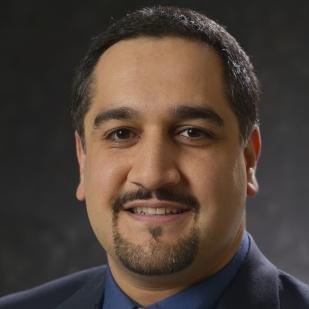
Dr. Hamed Okhravi is a senior staff member in the Secure Resilient Systems and Technology Group, where he leads programs and conducts research in the area of systems security. His research interests include cybersecurity, science of security, security evaluation, and operating systems. He is the recipient of the Stratus Award for Cloud Computing (2020), two R&D 100 Awards (2020 and 2018), MIT Lincoln Laboratory’s Best Invention Award (2019), MIT Lincoln Laboratory’s Team Award (2015), National Security Agency's 3rd Annual Best Scientific Cybersecurity Paper Competition Award (2015), and MIT Lincoln Laboratory’s Early Career Technical Achievement Award (2014) for his research. He is an associate editor of the IEEE Security & Privacy journal. He has also served twice as the program chair for the ACM Moving Target Defense (MTD) workshop, the poster chair of the IEEE SecDev Conference, and a guest editor of the IEEE Security & Privacy – Special Issue on Hacking without Humans. In addition, he has served on the steering committee of the ACM MTD workshop, and as a program committee member for many academic conferences and workshops including NDSS, USENIX Security, ACM CCS, RAID, AsiaCCS, IEEE DAC, IEEE SecDev, IEEE/ACM ICCAD, MILCOM, and ACNS, among others. He has also served on the National Science Foundation's Panel for the Secure and Trustworthy Cyberspace program. Dr. Okhravi actively contributes to various national, Laboratory, and division-level strategic planning activities, and has led the development of multiple national-level R&D roadmaps. He has also led the development of multiple systems security technologies that have successfully transitioned outside and inside Lincoln Laboratory. His work has resulted in multiple U.S. patents and numerous publications in top-tier venues. Dr. Okhravi’s current focus is researching and developing a Resilient Mission Computer, a new computer system design in which important security properties are inherent and multiple large classes of vulnerabilities are prevented by design. Dr. Okhravi earned his MS and PhD degrees in electrical and computer engineering from University of Illinois at Urbana-Champaign in 2006 and 2010, respectively. Okhravi was named a co-chair of a new study for the Defense Advanced Research Project Agency (DARPA) in October 2021.
Dr. Okhravi is a senior staff member in the Secure Resilient Systems and Technology Group at Lincoln Laboratory. Okhravi and his team have identified as the three root causes of cybersecurity vulnerabilities in modern computer systems. These vulnerabilities are consequences of computer design choices made decades ago for early computer systems. The issues involve the use of unsafe programming languages, the lack of security checks being performed by the computer processor, and the structure of operating systems. By addressing these issues, a large percentage of cyberattacks could be prevented. Okhravi and his team are currently working on developing a “practical and feature-rich” operating system that is secure by design." They are also working with MIT campus researchers to develop proof-of-concept technologies. Recently, Okhravi received a 2020 Stratus Award, as well as an R&D 100 Award, for his work on a technology that protects commodity software from malicious cyberattacks.